
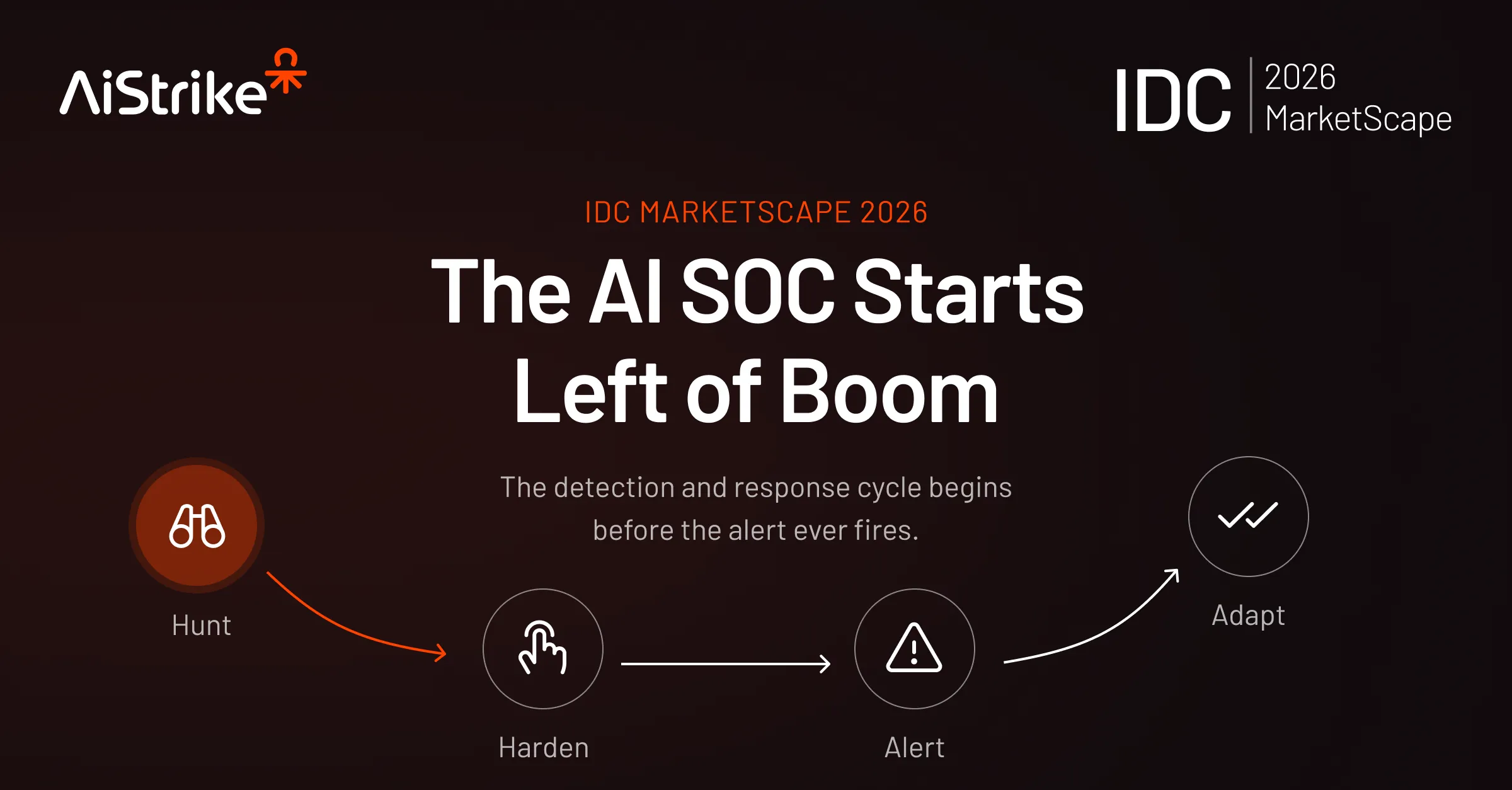

In September 2026, IDC named AiStrike a Leader in the IDC MarketScape: Worldwide Standalone AI SOC Platforms 2026 Vendor Assessment (read the announcement).
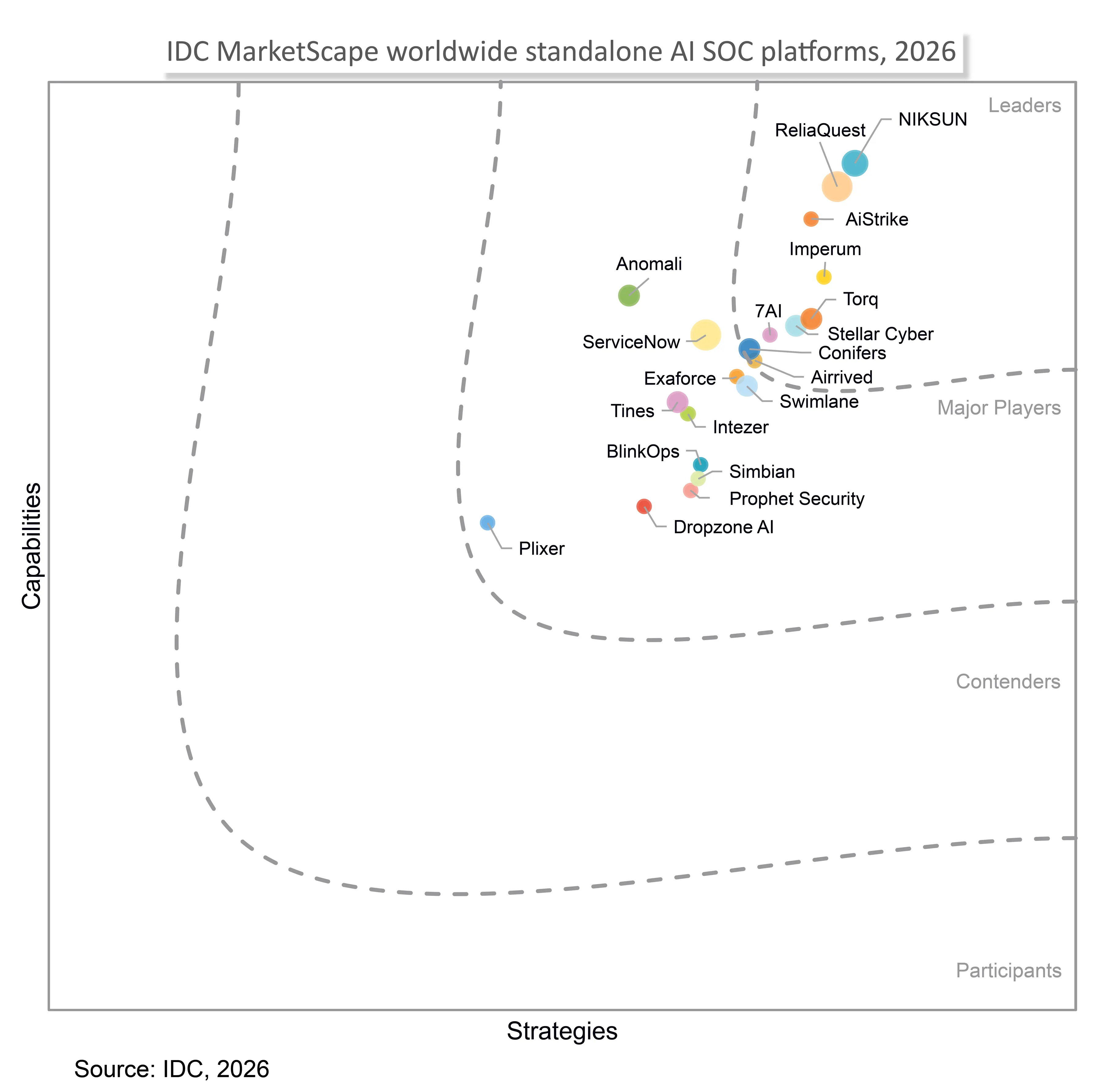
Source: IDC MarketScape: Worldwide Standalone AI SOC Platforms 2026 Vendor Assessment, September 2026, IDC #US54127026.
We are proud of that. But a position on a chart helps no one run a SOC. The report is more useful for what it says about where security operations is going, and what buyers should demand from any AI SOC platform, including ours.
Here are five takeaways we think matter most for SOC leaders, and what each one means for how we build AiStrike.
1. The bottleneck moved from data to decisions
IDC's survey work found that 63% of organizations experience alert overload frequently or worse. The most-cited reasons analysts cannot investigate every alert are false positives and process limitations, not staffing gaps. IDC concludes that the bottleneck "has shifted from data collection to correlation, triage, and decision-making."
That changes the question. If the problem is bad alerts and broken processes, processing the queue faster only gets you to the wrong answers sooner.
The bigger win is fewer bad alerts reaching the queue in the first place. That means closing the exposures attackers would use and fixing the noisy detections that flood analysts, before either one turns into a ticket.
2. The SOC starts left of boom
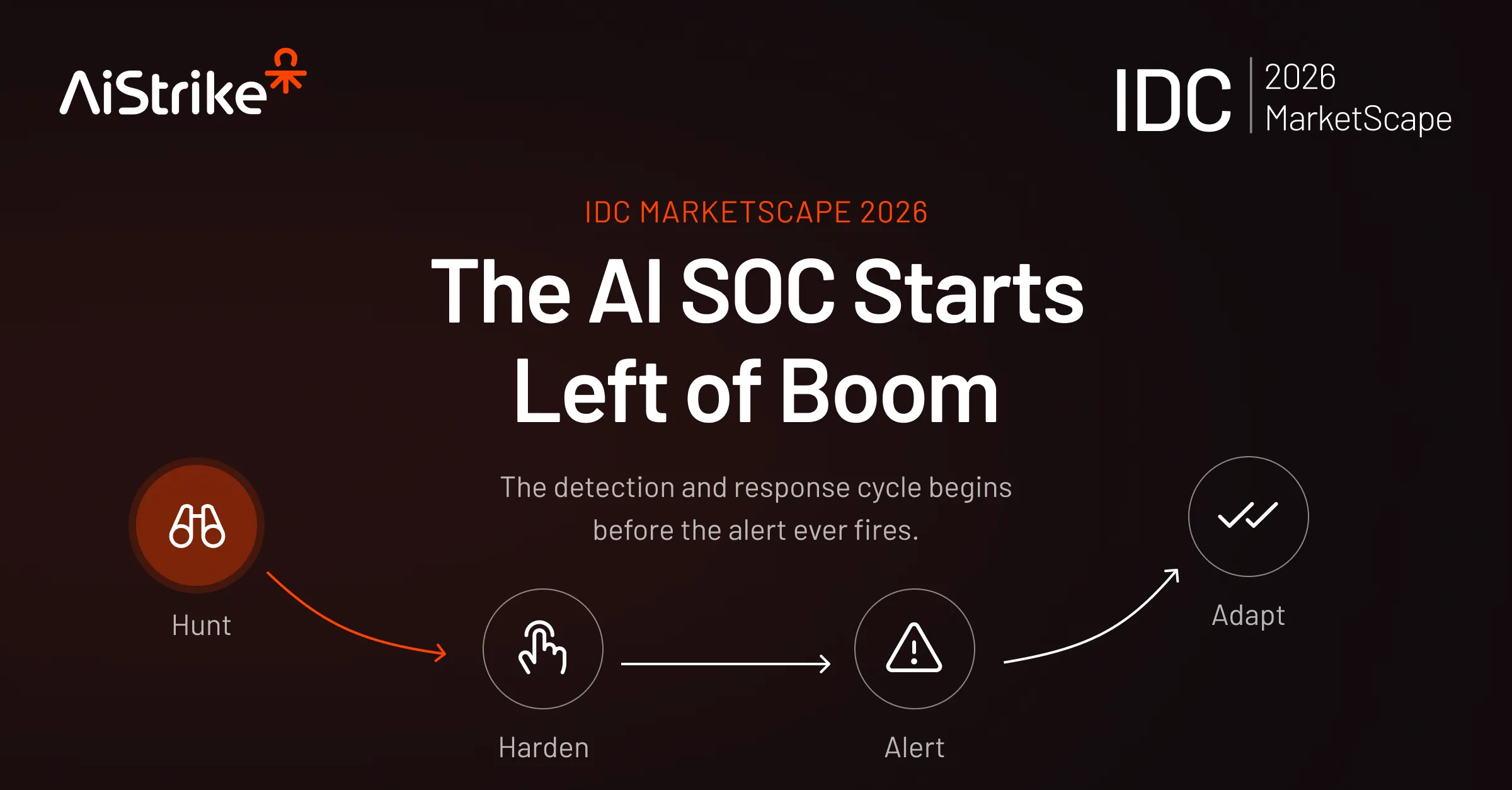
The line from the report we would underline twice: "the detection and response cycle begins 'left of boom.'"
IDC notes that providers who add exposure management, vulnerability scanning, attack surface management, and similar capabilities are reducing the blast surface proactively, "and consequently getting better alert fidelity." Its advice to buyers is to treat preventive and proactive measures "as a continuous loop that ties in with detection and response."
This is what we mean by preemptive security operations.
Before an alert fires, AiStrike hunts on fresh intelligence, prioritizes vulnerabilities by active exploitation, exposure, and asset criticality, and closes attack paths and misconfigurations.
During an alert, it investigates and responds autonomously, with human oversight where appropriate.
After an alert, every outcome feeds back into hunting and detection engineering.
IDC called out our closed-loop detection engineering "rather than queue processing" and our closed-loop threat hunting, where findings from intelligence-driven and hypothesis-driven hunts "feed directly back into detection engineering."
That loop is the product.
3. Detection engineering needs an owner
An AI SOC that investigates alerts but doesn't improve the detections generating them is only solving half the problem.
IDC tells buyers to ask a question most vendors skip: Who actually owns detection engineering?
Some platforms only consume whatever fires in the SIEM and leave the rules to the customer. That means keeping detection engineering skills in-house indefinitely. IDC is also blunt about rules themselves: they "require constant tinkering and updating."
Our answer is to make detection engineering continuous.
AiStrike measures how well a customer's existing rules perform and how much of MITRE ATT&CK they cover. It identifies noisy or ineffective rules and coverage gaps, then generates, tunes, tests, and deploys corrected detections back into the customer's SIEM or EDR.
It also watches for drift, such as a rule that goes silent after an environment change.
Feedback from investigation and response feeds that work, so detections improve with every case.
The goal isn't just faster investigations. It's a detection environment that continuously improves.
4. Evidence beats claims
IDC is direct about vendor numbers: treat them "as a starting point for questions, not a conclusion."
Ask for the denominator behind every headline statistic, and for the same metric calculated on your own data during a proof of concept.
The survey shows why this matters. Ninety-one percent of respondents said that verifying an autonomous action happened, and that risk actually went down, is the ultimate goal of automation. Only 26% rely on automated evidence collection to confirm it today.
We built AiStrike so the evidence is never optional.
Every alert gets a multistage investigation that ends in a verdict, a confidence score, and a rationale. The queries, data sources, correlations, and evidence behind it are retained, so an analyst can verify how the platform reached its conclusion.
When an investigation is incomplete, AiStrike says so instead of presenting it as final.
What this looks like in practice
In one representative week after go-live, AiStrike delivered the following outcomes for a publicly traded enterprise with more than 10,000 employees:
The result was 90% fewer tickets, approximately 98% faster investigations, twice as many true positives identified, and 50% lower operating costs.
But the important outcome isn't just faster investigation. The organization also gained proactive threat hunting, improved detection coverage, and threat-informed vulnerability prioritization.
These figures represent one week of outcomes from a single customer engagement and are not guarantees of results for other organizations.
This is what buyers should expect from an AI SOC proof of concept: measurable improvements in operational efficiency, detection effectiveness, and risk reduction, supported by evidence.
5. Extend the stack, then shape it to your environment
Roughly 74% of organizations IDC surveyed own a SIEM and expect a standalone AI SOC tool to work with it. API-based integration into existing workflows was the most-preferred deployment model.
IDC's advice: weigh integration depth and coexistence with what you already run as heavily as any autonomy claim.
IDC also warns against taking plug-and-play claims at face value. One reference customer said meaningful value required building custom agents and workflows for its own tools.
IDC adds that "the AI harness matters": custom agents should be checked before deployment for data leakage, hallucination, and access they should not have.
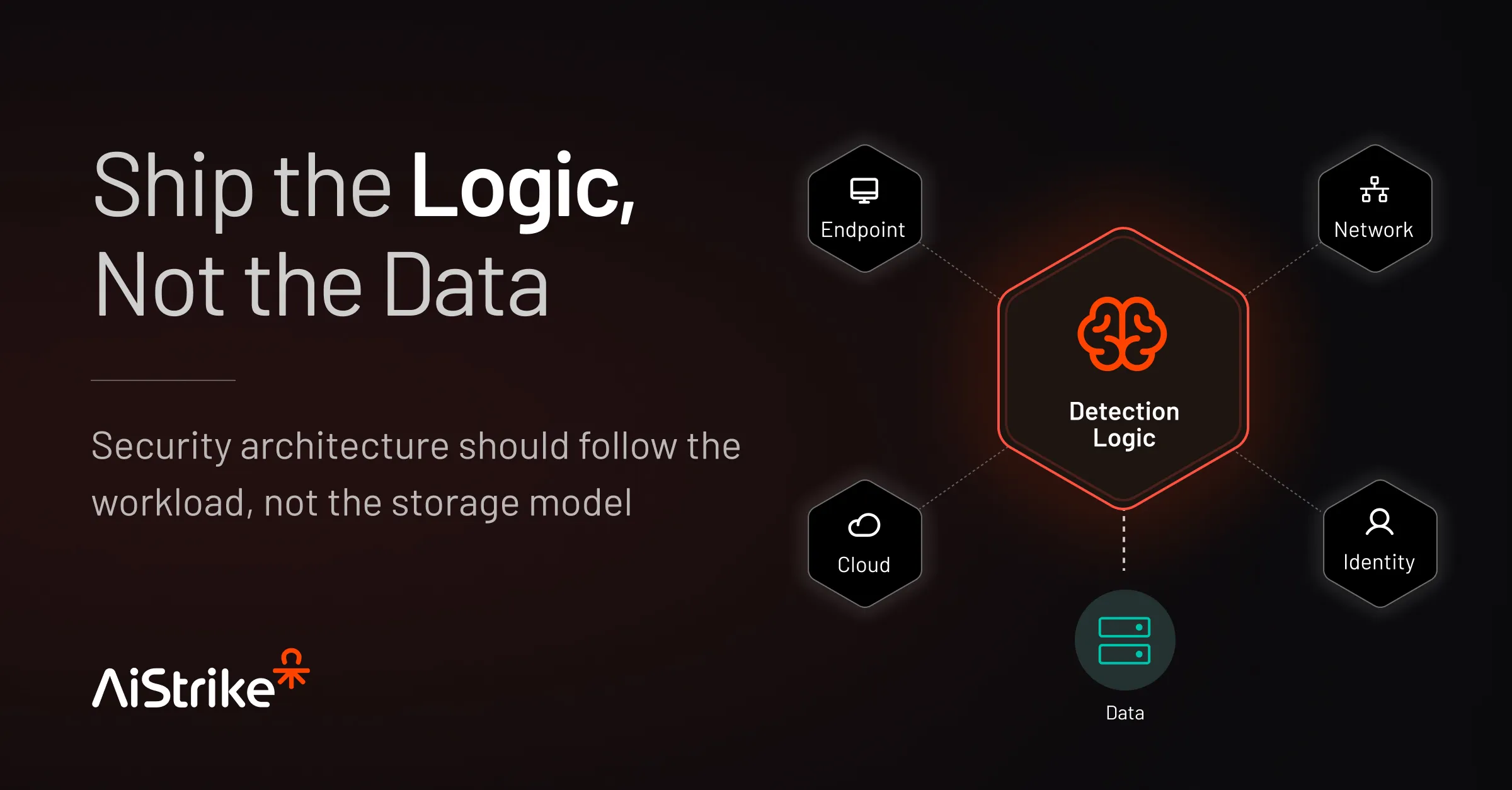
AiStrike runs as an agentless, API-based layer on top of the SIEM, EDR, cloud, and identity stack, as SaaS or in the customer's own cloud.
Customers can build their own agents or bring their own models, governed by role-based permissions and tiered, risk-based approvals.
In one example IDC cites, a customer-built agent that validates and executes firewall change requests from a ServiceNow ticket reduced processing time from approximately 30 minutes to under three minutes per ticket, with sensitive changes still approved by a human.
The lesson is straightforward: autonomy must fit the customer's environment, not force the customer to rebuild around the platform.
What to ask any AI SOC vendor
The report reads best as a buyer's checklist. Before you shortlist anyone, including us, ask:
- What happens before the alert? Show me how hunting, exposure management, and detection engineering feed each other.
- Who owns detection engineering? How do rules get tuned when they drift, become noisy, or go silent?
- What is the denominator behind your headline metrics? Can you calculate the same metrics using my data during a proof of concept?
- How do you verify that an action worked? Can you demonstrate that risk actually went down?
- How do you govern autonomous response? Walk me through one high-impact action end to end, including human approval and rollback.
- How do your agents adapt to my environment? What does customization require, and how are agents governed once deployed?
The next AI SOC won't just process alerts faster
It will continuously reduce the conditions that create security risk, improve the detections that identify threats, investigate and respond with evidence, and learn from every outcome.
As our founder and CEO Nitin Agale put it when the report came out: "AI threats need AI defense. And the SOC has to get better with every investigation."
That's the shift from reactive security operations to preemptive security operations.
It's the operating model we're building at AiStrike.
Read the 2026 IDC MarketScape excerpt → https://www.aistrike.com/idc-marketscape
Source: IDC MarketScape: Worldwide Standalone AI SOC Platforms 2026 Vendor Assessment, September 2026, IDC #US54127026.
IDC MarketScape vendor analysis model is designed to provide an overview of the competitive fitness of technology and service suppliers in a given market. The research methodology utilizes a rigorous scoring methodology based on both qualitative and quantitative criteria that results in a single graphical illustration of each vendor’s position within a given market. The Capabilities score measures vendor product, go-to-market and business execution in the short-term. The Strategy score measures alignment of vendor strategies with customer requirements in a 3-5-year timeframe. Vendor market share is represented by the size of the circles. Vendor year-over-year growth rate relative to the given market is indicated by a plus, neutral or minus next to the vendor name.


.avif)
.avif)
.avif)
.avif)
.avif)


.avif)
.avif)
.svg)
.webp)