
Advisory Detail
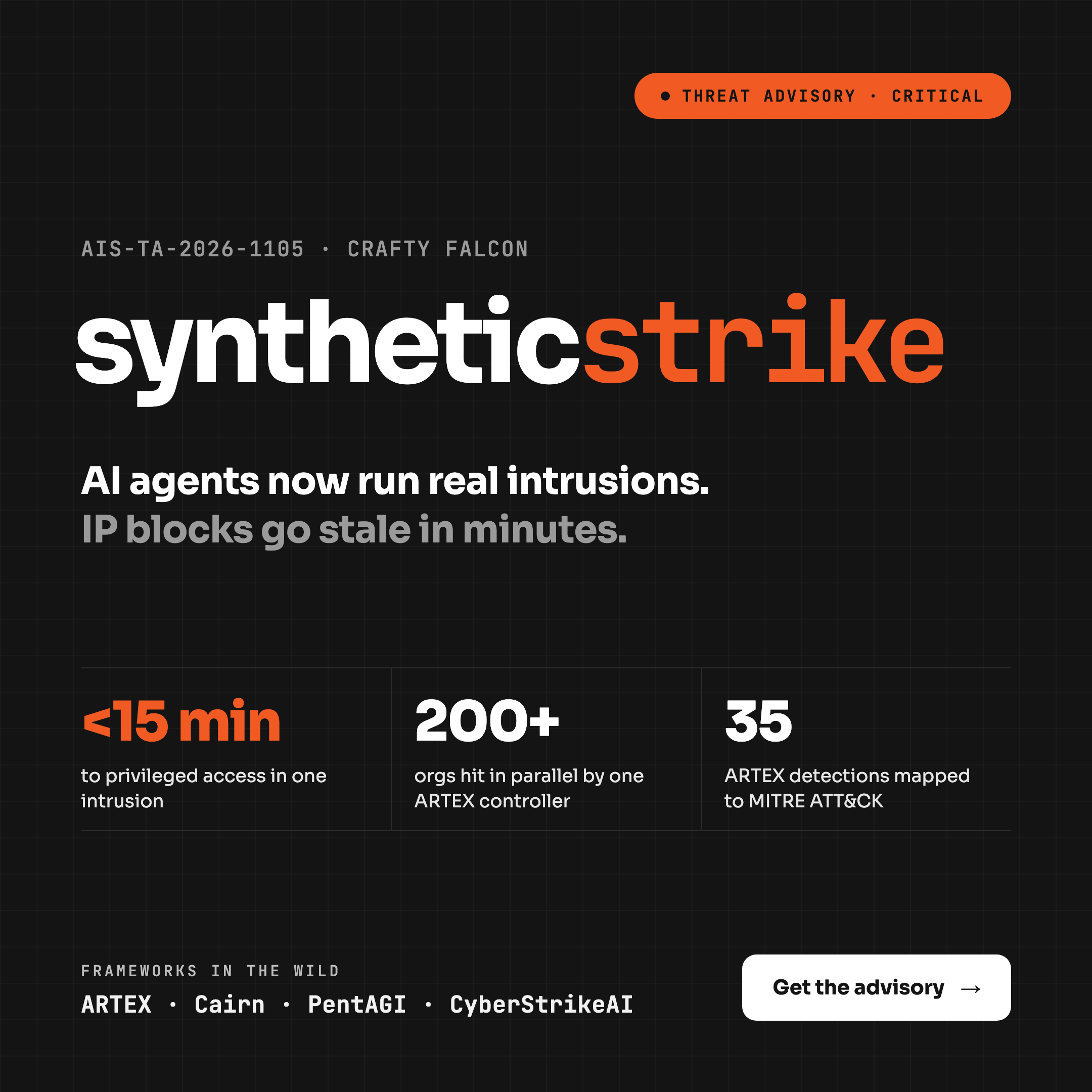
Multi-agent AI pentest frameworks have moved from the lab into real intrusions. Since late August 2026, attackers have used ARTEX, Cairn, PentAGI and CyberStrikeAI to run password sprays, OAuth abuse, SQL injection, webshells and Kerberoasting much faster and at far greater scale than a human operator could. CERT-In's finance CSIRT tracks one of these groups as CRAFTY FALCON. It surveys Indian NBFCs, fintechs, payment aggregators and crypto exchanges, then moves money out through each victim's own payment and disbursement APIs. China-nexus and Russian espionage groups, ShinyHunters affiliates and card-skimming crews use the same tooling. One controller hit more than 200 organisations at once, one intrusion reached privileged access in under 15 minutes, and a successful breach costs the attacker about $25–50.
Blocking IP addresses won't contain this threat. The operators rotate infrastructure, user agents and models within minutes, so static IOCs go stale quickly. Defenders need to hunt on behaviour. Signs to look for include bursts of requests paced like model inference, downloads of OpenAPI specs or source maps followed by calls to internal APIs, writes immediately followed by a read-back, and the ARTEX and CyberStrikeAI fingerprints. Search back at least 90 days.
To help security operations centres (SOCs) respond, AiStrike delivers an end-to-end detection and response framework. The AiStrike platform automatically correlates weak signals into a single AI-triaged case enriched with exposure context. It also gives security teams 35 ready-to-deploy ARTEX detections mapped to MITRE ATT&CK, behavioural indicators of attack for retroactive threat hunting, and automated playbooks to isolate compromised hosts and rotate exposed secrets.
Download the full white paper for the technical breakdown of each actor and framework, sample SQL detection rules, and the complete list of IOCs.
Advisory on Emerging AI Offensive Frameworks