
The AI SOC market is flooded with messaging that targets the wrong thing. Machine speed. Broad agentic claims. Agents for everything. It sounds good on a slide, but it rarely tells you whether the system will be right in your environment six months from now.
What's interesting is that the capability that matters most, continuous learning through a real feedback loop, is the one the market talks about the least. We think that's because it's the hardest to implement right.
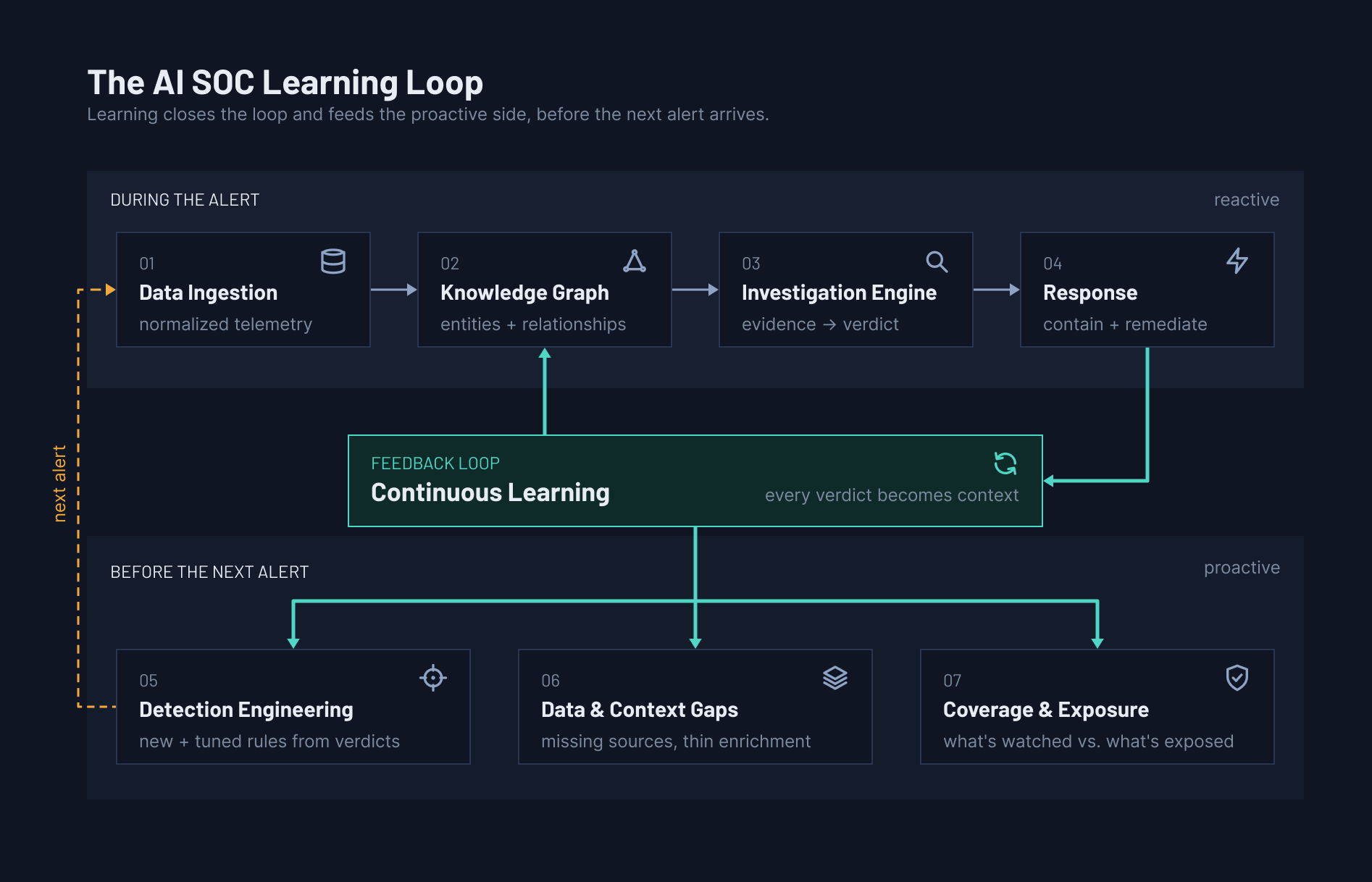
First, learning rarely works bolted onto a product. It needs the right components underneath: data, context, investigation and response, connected so every outcome feeds back into the system. Second, learning has to point forward. In our previous post we wrote about why the SOC needs to be preemptive. If the loop only makes the next triage faster, you've just improved your reactive side. The value comes when what the system learns flows into detections, coverage and exposure before the next alert.
This post walks through the core components, why you need all of them, the learning gap in the market, and the one basic that decides whether any of it works: the context you own.
The core components, and why you need all of them
At AiStrike we build the platform around four core components. Each one fails in a specific way when it's missing.
- Data ingestion. Not just alerts. Enrichment, cases, documentation, past incidents and the logic of the rule that fired. In AiStrike, AI identifies new data sources and builds parsers on the fly, and federated search queries across sources and SIEMs in natural language. Without this layer, the agent often investigates an alert it doesn't fully understand.
- Knowledge graph. The brain: asset ownership, identity context, change requests, past incidents, baselines of normal. AiStrike keeps an inventory of hosts, systems and users, and behavior analytics baselines normal user activity. Without it, verdicts stay generic, because the agent doesn't know your environment.
- Investigation engine. ML for speed on volume, deterministic workflows for predictability, LLMs for the ambiguous cases. AiStrike stitches events using MITRE ATT&CK, builds timelines and automates the investigation. Correlating is half the job. Re-scoring severity is the other half, and it's often skipped.
- Response and feedback loop. Containment, documentation, and suggestions that flow back into detections, log sources and playbooks. AiStrike's knowledge base holds playbooks, training data and feedback loops, and Agent Studio lets teams put their own logic into the agents. Without it, the system will probably make the same mistake next week.
These are a chain, not a menu. The weakest component sets the ceiling for the whole system. A strong investigation engine on top of stale context doesn't give you good answers, it gives you confident wrong answers at machine speed. That's the problem with leading on speed: speed only helps if the verdict is right.
This lines up with what SecOps Unpacked sees in its AI SOC Core Components 2026 research, which breaks the AI SOC into the same four parts and treats the knowledge graph as the basis for how well the whole system works.
Why is the industry not talking about continuous learning?
Because it's the hardest part to get right. At AiStrike, it's where we've spent a lot of our time. Out-of-the-box agents handle 70 to 80% of the work. The knowledge base and the feedback loop are what take accuracy from 80% to 98%, by learning the customer environment.
That last stretch is your environment: the exceptions, the service account that always does that, the change window that was never documented. That knowledge usually isn't written down, and feedback is the main way an AI SOC picks it up. If your AI SOC has no proper feedback loop, it probably won't learn the stuff that isn't written down.
The market data points the same way. SecOps Unpacked's BuzzScan of AI SOC vendor messaging found that 88% of vendors lead with machine speed, while only 23% mention continuous learning at all.
One warning. Learning from your old tickets is not the same as learning. Years of "closing as FP" with no reasoning are bad ground truth. Garbage labels in, confident garbage out. The loop has to start from good feedback going forward.
This is also what makes a SOC preemptive rather than just faster. A system that learns from every outcome feeds detection engineering and coverage gaps before the next alert, not after it.
Context you own: why your CMDB still decides the outcome
AI SOC doesn't replace the basics. It runs on them. An agent can ask the EDR about a host and the IdP about a user. Neither tells it who owns the box or how critical it is. In most orgs that answer lives in a CMDB nobody updates, a spreadsheet, or someone's head.
That creates two failure modes.
- No context. The agent guesses criticality, and the guess drives severity, escalation and response.
- Context lock-in. The vendor builds your context inside its own black box. You can't check it, correct it, or take it with you when you switch.
Maintaining your own context is not optional anymore, it's the input your AI depends on. That means a system of record for asset ownership, criticality and identity that belongs to you, is machine readable, and stays current through change and exception management. Documentation written for humans needs to be translated into something an agent can query.
The good news: this is where AI actually helps with the basics. The platform sees your hosts, systems and users every day, so it should help build and maintain the inventory instead of waiting for someone to update a spreadsheet. And the learning loop should write back into it. When an analyst says "that's the backup server, it does that every Sunday," that belongs in your context layer, where you can see it and fix it.
The ground rule hasn't changed: fix your asset and identity data first.
How AiStrike approaches it
At AiStrike we built for the part that doesn't demo well. Out-of-the-box agents handle 70 to 80% of the work. The knowledge base and the feedback loop are what take accuracy from 80% to 98%, by learning the customer environment.
- Knowledge base holds playbooks, training data and feedback loops, and feeds them back to the agents.
- Agent Studio lets teams put their own logic into agents: tools, knowledge, models, routing and reasoning, with traces to evaluate how each agent performs.
- Inventory keeps track of hosts, systems and users, with a natural language interface to query it.
- Behavior analytics baselines normal user activity, so anomalies are measured against your environment, not a generic one.
Agentic is the label. Learning and context are the system. Only 23% of the market talks about the part that makes the agent better every week.