A Parallel Universe of Insiders

Blog
13/11/2026

A Parallel Universe of Insiders

Nitin Agale
Founder and CEO
The next insider may not be human.
Table of Contents

For a decade, insider threat meant people. Some were intentional: stealing data, sabotage.Most were accidental: a malicious download, a confidential file sent to a personal email.

There is now a second population of insiders, and it is growing faster than the first. AIagents have permissions, they act on their own, and they can be misused orcompromised.

With people, we at least knew what to collect. The activity was logged, and the hard partwas the analytics. That is the problem UEBA set out to solve, and it partly did.

Agents break both halves

Agents make the data problem and the analytics problem harder at the same time.

Intent is hard to trace. An agent calls sub-agents, and those spin up their own activity.The instruction that started the chain can be several steps removed from the action thatmatters.

Telemetry is patchy. Enterprise AI tools expose some events. ShadowAI exposes almostnone without something on the host.

Baselines don't fit. Most SIEM and UEBA tools baseline users, hosts and IPs. An agent is astrange combination of all three: it carries a user's permissions, runs on a host and talks tothe network like a service.

The developer, the agent, or a compromise?

Picture a coding agent running with a developer's permissions. It pulls a repository andsends it to an external API.

Three explanations fit the same log line. The developer asked for it. The agent is doing itsjob, perhaps calling a hosted model. Or the agent has been compromised, for example byinstructions hidden in a file it read. Most tools today cannot tell you which.

What separates them is context that no single tool holds:

Signal What it tells you
The prompt and tool calls that led to the action Whether a person asked for it or the agent decided on its own
Whether the destination is a sanctioned AI service Normal work or data leaving the company
The developer's own recent behavior Whether there is a reason to suspect intent, such as a resignation
What else the agent and its sub-agents did in that session One odd action or a pattern

Each signal is weak alone. A developer who has given notice, an agent reachingrepositories outside its usual scope, and an unsanctioned destination are a toxiccombination. You only see it when human and agent behavior sit in the same model.

AIDR is necessary, and it is half the answer

The industry's answer so far is AIDR, AI detection and response: watch the agents, catchthe prompt injection, stop the unsafe action. That is necessary.

But it treats agents as a new silo, sitting next to the UEBA silo we built for people. Anagent's behavior only means something when you can tie it to the user who launched itand the host it ran on. UEBA and AIDR are two halves of the same question.

Where the signals come from

The two kinds of insider leave their traces in different places, which is why they ended upin different tools.
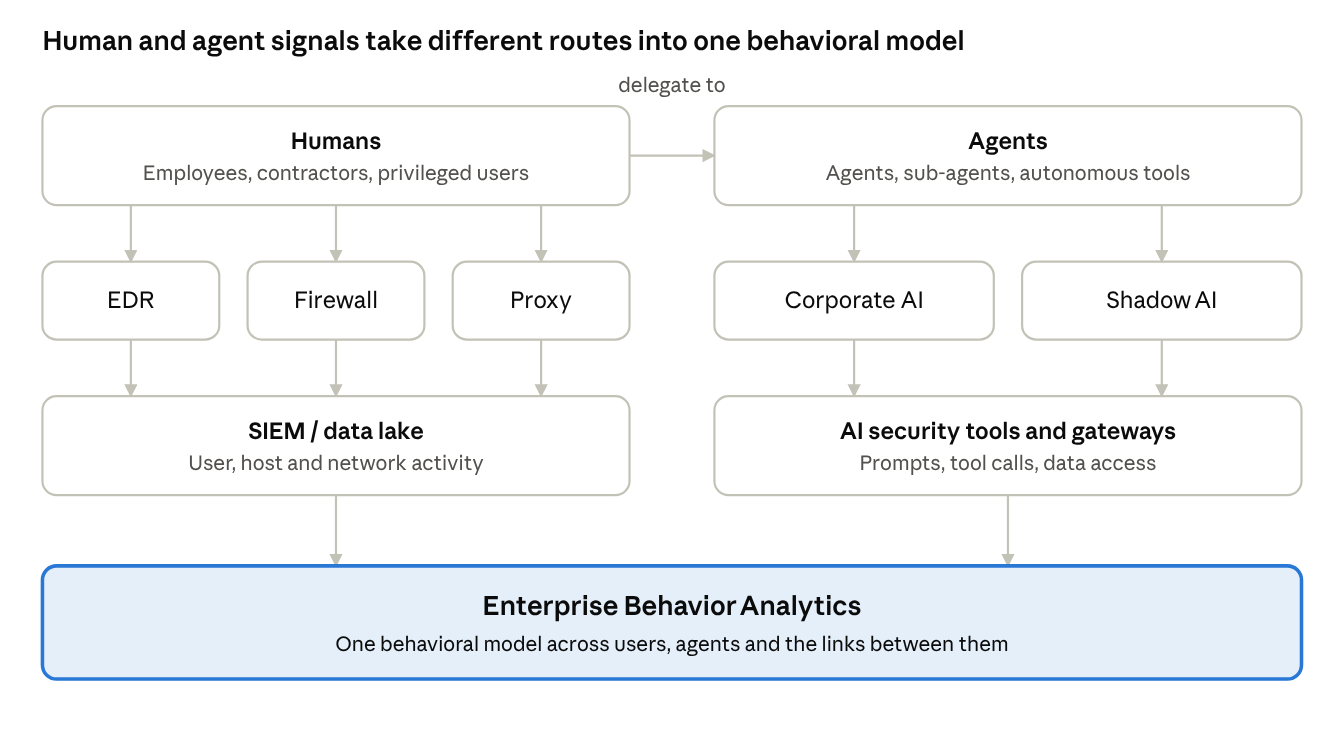
Where human and agent signals come from · two routes, one model

Human activity reaches the SIEM or data lake through EDR, firewalls and proxies. Agentactivity is visible through AI security tools and gateways, and for shadowAI often onlyfrom the host.

Three things have to change

1. The definition of an insider. It has to cover virtual users as well as human ones, underone behavioral model. In practice, every agent needs what every employee already has: anidentity, an owner, a set of permissions and a baseline of normal behavior.

2. The frameworks. MITRE ATT&CK describes what adversaries do to systems. MITREATLAS describes what happens to and through AI. For human insiders, Forscie's InsiderThreat Matrix plays the same role. You need all of them mapped to the same activity, sothat an agent's tool call and a user's file download can be read as steps in one story.

3. The chain of accountability. Every agent and sub-agent action has to tie back to theuser who launched it and the host it ran on. Without that link there is no intent to analyze,only activity.

Enterprise Behavior Analytics

An advisor of ours calls this Enterprise BehaviorAnalytics, and I think the name fits. Thequestion is no longer what your users are doing. It is what everything acting on yourbehalf is doing.

This is what we have been building at AiStrike. We treat AI-agent activity, meaningprompts, tool calls, API calls and data access, as security telemetry alongside user andhost activity. Events are classified against MITRE ATLAS and the Insider Threat Matrix.Related anomalies across a user and the agents acting for them are stitched into one case,not scattered across two tools.

We built it with our design partners, and we are making it available to AiStrike customers.

Data sheet: [LINK]

Related: Agents watching agents and Insider threat has outgrown legacy UEBA
Latest Resources

All Resources
Blog
November 13, 2026

A Faster AI SOC Is Still a Reactive SOC

In our last post, we argued that many organizations have been buying half of security operations: the reactive half. Faster investigations, quicker decisions, more alerts closed. That matters. But think about what happens after the ticket closes.
Read More
Blog
October 21, 2026

Have You Been Buying Half of SecOps?

Why most AI SOC tools stop at the reactive half, and what closing the loop takes
Read More
Blog
October 12, 2026

The AI SOC Starts Left of Boom

Five takeaways from the 2026 IDC MarketScape, and what to ask any AI SOC vendor.
Read More
Case studies
October 28, 2025

How Sunrun Transformed Security Operations with AiStrike

Transforming to an AI-Powered Self-Improving SOC
Read More
Case studies
October 2, 2024

Global Software Design Company Leverages AiStrike to Investigate Cloud Alerts

Global Software Design Company Leverages AiStrike to Investigate Cloud Alerts
Read More
News
September 30, 2026

AiStrike Named a Leader in 2026 IDC MarketScape for Worldwide Standalone AI SOC Platforms

AiStrike helps organizations get ahead of AI-powered threats with autonomous security operations that grow stronger with every investigation.
Read More
News
March 23, 2026

AiStrike Takes on Alert Fatigue with Continuous Detection Engineering at RSA 2026

AI-native platform improves detection quality to cut alert noise, eliminates detection blind spots, and maximizes SIEM ROI through continuous optimization
Read More
News
February 4, 2026

AiStrike Launches AI-Native MDR to Replace Traditional Managed Detection and Response

SAN FRANCISCO, CA – [02-04-2026] – AiStrike, an AI-native cyber defense platform built for modern security operations, today announced the launch of AiStrike MDR, an AI-powered Managed Detection and Response (MDR) service designed to replace traditional, human-heavy MDR with an AI-led, expert-guided operating model built for scale, speed, and measurable outcomes.
Read More
News
January 21, 2026

AiStrike Raises $7M to Accelerate AI-Native, Preemptive Cyber Defense

The era of purely reactive security operations is over. AiStrike, a cybersecurity company pioneering AI-native, preemptive cyber defense, today announced it has raised $7 million in Seed funding to scale its agentic AI platform for security operations. The round was led by Blumberg Capital, with participation from Runtime Ventures, Oregon Venture Fund, and strategic angel investors.
Read More
News
July 22, 2025

Harsh Patwardhan Joins AiStrike as Chief Technology Officer

Reuniting a Proven Leadership Team to Build the Future of Autonomous Security Operations.
Read More
News
April 24, 2025

AiStrike Announces AI Agents for Detection Optimization, Advancing the Complete AI-Augmented SOC

San Francisco, CA – April 14, 2025 – AiStrike, the AI SOC automation platform transforming cybersecurity operations, today announced the launch of its AI Agents for Detection Optimization—a first-of-its-kind capability that helps security teams improve detection quality, eliminate blind spots, and reduce alert noise by automatically identifying coverage gaps and tuning detections in real time.
Read More
News
May 22, 2024

AiStrike Emerges from Stealth to Solve Cloud Security Investigation and Response using AI-powered Automation

Guidelines for selecting the most suitable CMS for your project.
Read More
News
June 11, 2024

Cloud Security Operations Leader AiStrike Launches AI-Powered Cloud Security Investigation and Response Solution on AWS Marketplace

AiStrike leverages advanced AI and machine learning to automate the triage, investigation, and remediation of cloud-native threats, empowering organizations to rapidly respond to threats across all their AWS environments.
Read More
Datasheets
February 23, 2026

Preemptive AI SOC Platform for MSSPs

MSSPs are under constant pressure to support more customers and increasingly complex environments while maintaining consistent response, coverage, and service quality. Traditional MDR models rely heavily on manual investigation, detection tuning, and analyst-driven workflows, making it difficult to scale operations and deliver proactive outcomes across tenants.
Read More
Datasheets
September 14, 2026

Preemptive AI SOC Platform

Security teams are overwhelmed by alert volume while real threats still slip through. Traditional SIEM and XDR platforms generate high-noise signals, and many AI SOC tools focus on faster triage without addressing detection gaps or true risk exposure.
Read More
Solution Briefs
November 13, 2026

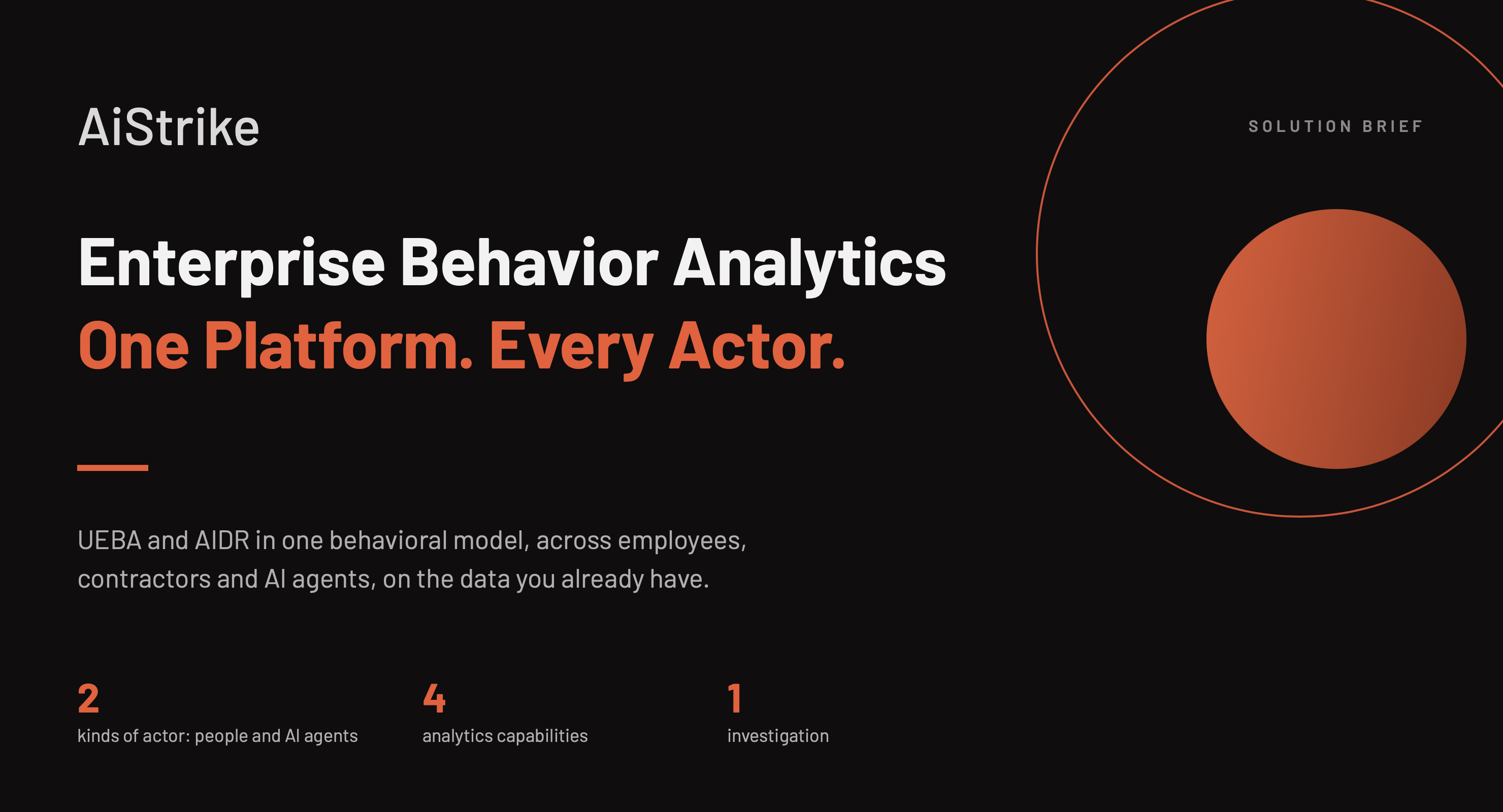
Enterprise Behavior Analytics

Enterprise Behavior Analytics is one behavioral analytics platform across human and AI actors. AiStrike unifies UEBA and AIDR to detect, investigate and respond to threats involving employees, privileged users, contractors and autonomous AI agents.
Read More
Solution Briefs
November 13, 2026

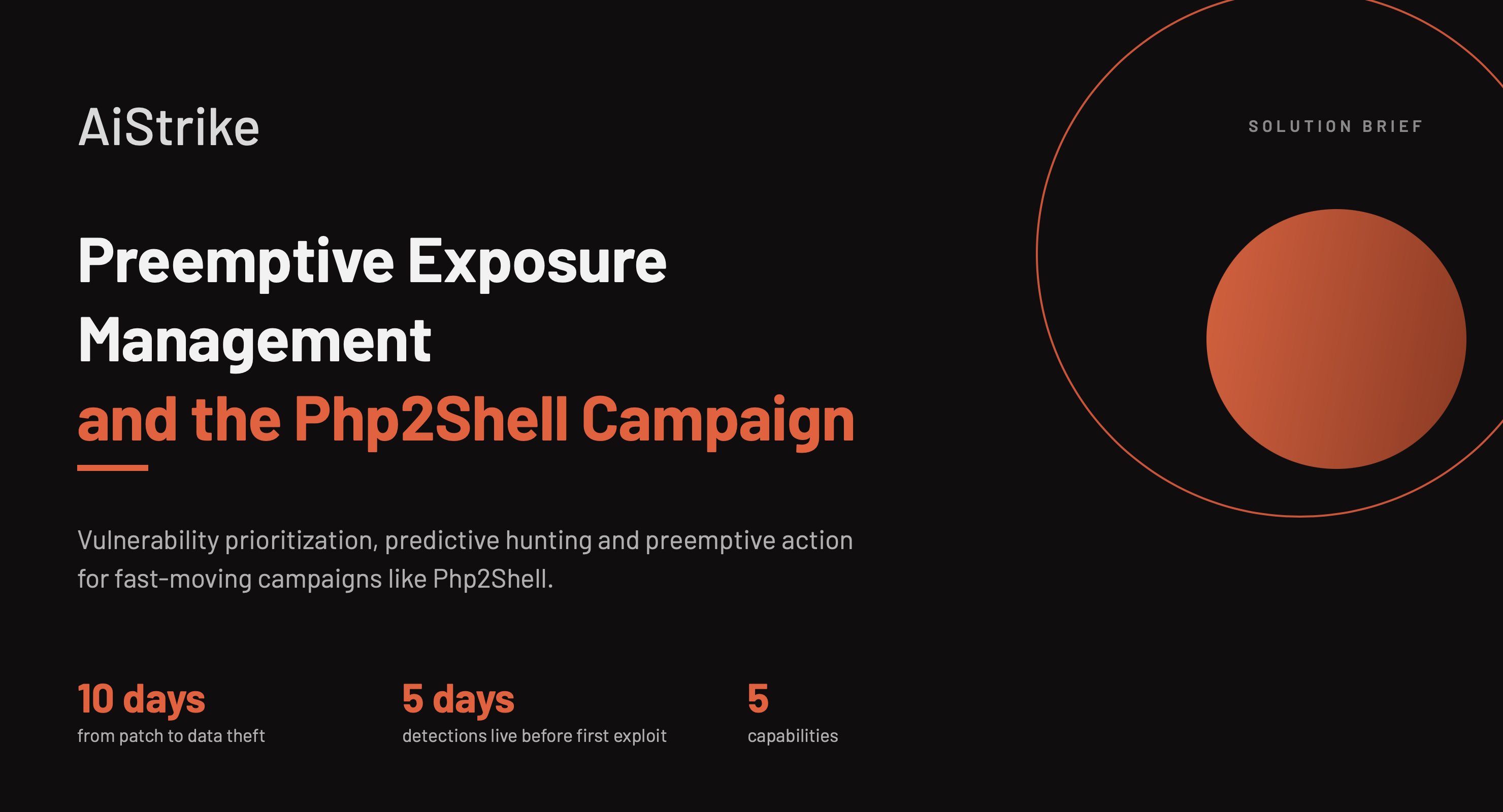
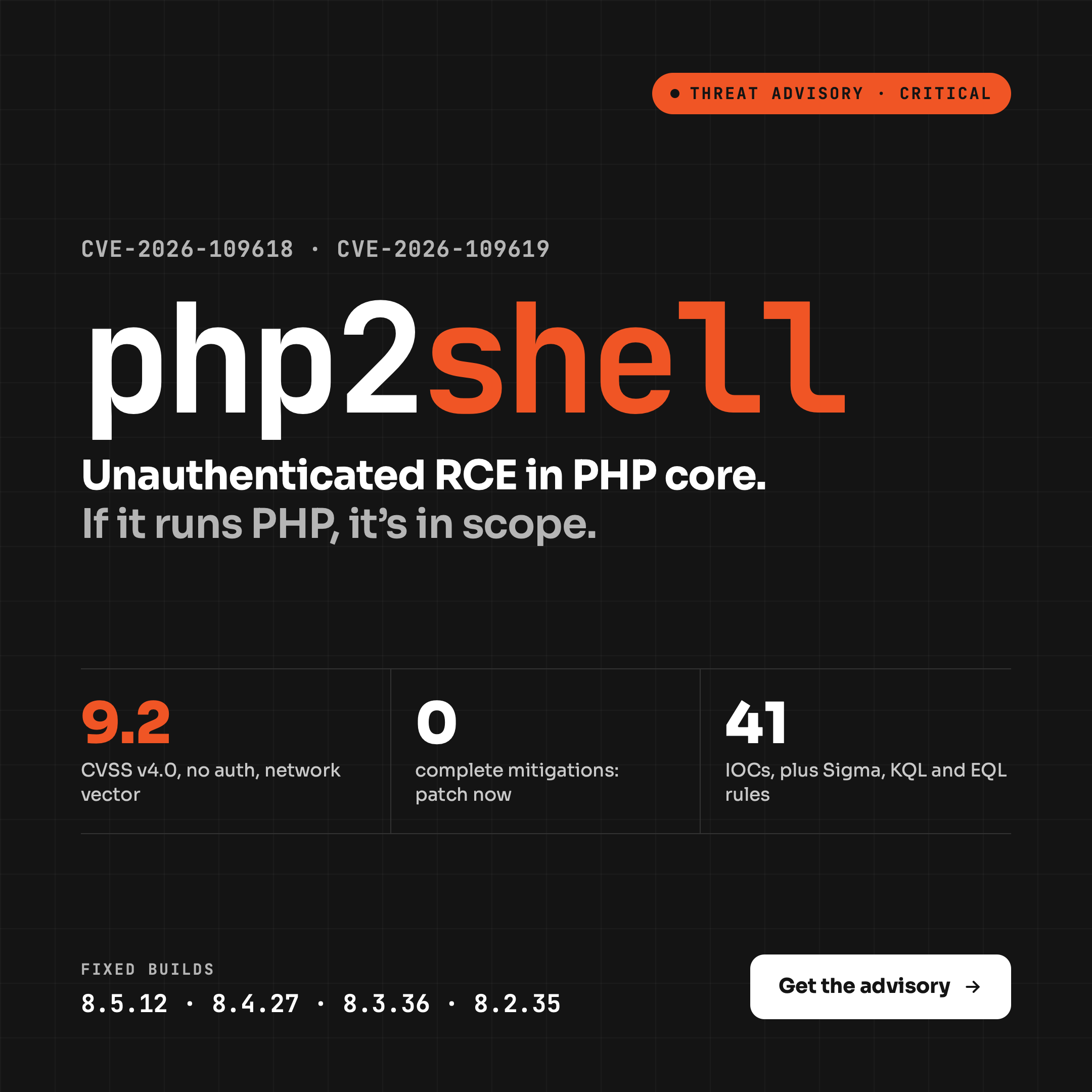
Preemptive Exposure Management and the Php2Shell Campaign

Php2Shell went from patch release to stolen data in ten days, and a CVSS score of 9.2 told no one which of their own servers mattered. AiStrike closes that gap. It works out which exposures are real in your environment, hunts for the campaign before an alert fires, and acts on what it finds.
Read More
Solution Briefs
September 14 , 2026

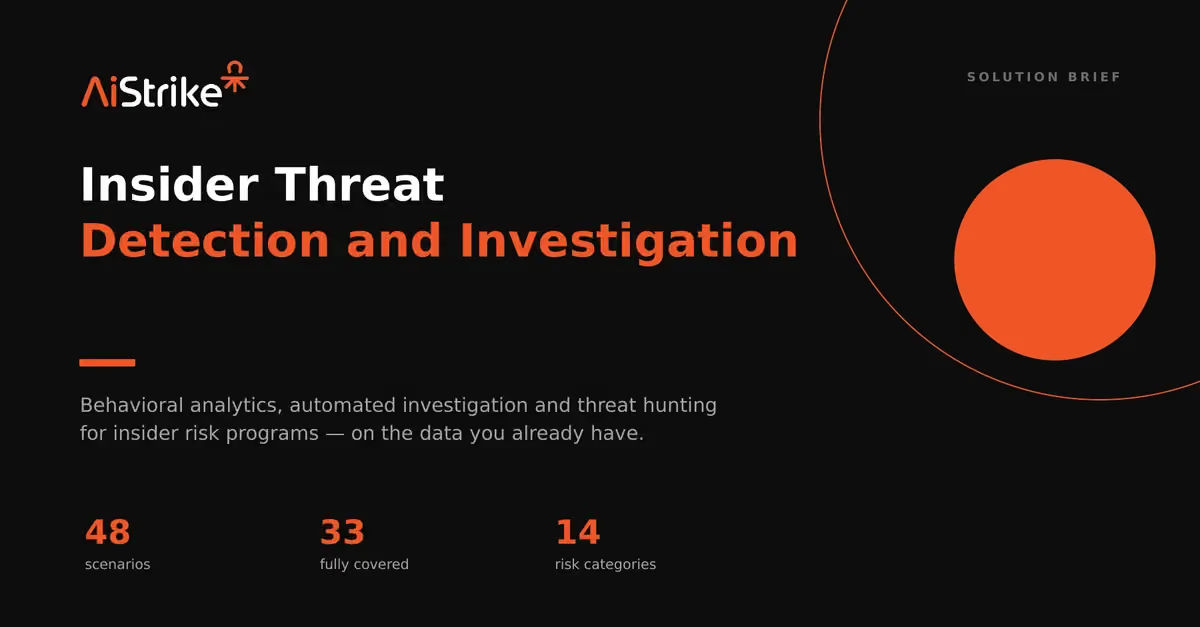
Insider Threat Detection and Investigation

Behavioral analytics, automated investigation and threat hunting for insider risk programs — on the data you already have.
Read More
Solution Briefs
July 27, 2026

IBM QRadar + AiStrike

Keep QRadar. Add an AI layer that investigates every offense, explains its reasoning, and tunes your detections over time.
Read More
Solution Briefs
July 25, 2026

AiStrike's Vulnerability Prioritization Agent ranks vulnerabilities by true exposure reachability, active exploitation and blast radius - not static CVSS.

AiStrike’s Vulnerability Prioritization Agent investigates every vulnerability with live threat, exposure, and business context, then ranks it by the exposure an attacker could actually use, and drives a remediation path that reduces risk whether or not a patch exists yet.
Read More
Solution Briefs
April 5, 2026

Use Cases

From Reactive SOC to Preemptive Security Operatins
Read More
Solution Briefs
May 23, 2024

AiStrike for AWS

Cloud infrastructure today is the primary target for malicious actors. The risk of exposure of cloud assets continues to grow as organizations expand their cloud footprint and new cyberattacks targeting cloud infrastructure emerge.
Read More
White Papers
November 6, 2026

Synthetic Strike: The AI Offensive Frameworks Redefining Cyber Warfare

AiStrike's Threat Advisory on Emerging AI Offensive Frameworks
Read More
White Papers
October 30, 2026

PHP2Shell Campaign Summary

PHP2Shell (CVE-2026-109618 and CVE-2026-109619) is a critical pre-authentication remote code execution flaw in PHP request handling, scored 9.2 on CVSS v4.0. From 21 October to 1 November 2026, GreyNoise recorded 245,083 attack sessions, including 213,331 exploitation attempts.
Read More
White Papers
October 23, 2026

PHP2Shell Advisory Report

AiStrike's PHP2Shell Advisory Report
Read More
White Papers
August 28, 2024

CISO Guide: AI-Automated Cloud Security Operations

This guide provides CISOs with a comprehensive understanding of how AI-driven automation can revolutionize cloud security operations, enhancing both efficiency and effectiveness.
Read More
Blog

A Parallel Universe of Insiders

The next insider may not be human.
Read More
Blog

A Faster AI SOC Is Still a Reactive SOC

In our last post, we argued that many organizations have been buying half of security operations: the reactive half. Faster investigations, quicker decisions, more alerts closed. That matters. But think about what happens after the ticket closes.
Read More
Blog

Have You Been Buying Half of SecOps?

Why most AI SOC tools stop at the reactive half, and what closing the loop takes
Read More