
The same noisy detection fires next week. The missing log source leaves the same blind spot. The exposed system stays buried in a vulnerability backlog nobody can prioritize. This time your AI SOC closes the alert in 30 seconds instead of 30 minutes. That’s an efficiency improvement. It isn’t necessarily a security improvement.
Most of the AI SOC conversation still starts with the alert: machine-speed triage, autonomous investigation, agents working a queue around the clock. Those are useful capabilities. The harder question is what the system changes before the next alert arrives.
That’s where preemptive security operations starts: an operational loop that connects what the SOC learns during investigations to the detections, data, context, and exposures it can improve upstream.
Speed doesn’t change the question
Reactive operations asks what happened, whether it’s malicious, and what needs to be contained right now.
Preemptive operations asks something different:
- What did this incident teach us?
- Which technique could we have detected sooner?
- Which telemetry was missing?
- Which vulnerable or misconfigured asset made the attack possible?
- What should we change so the next attempt has less room to succeed?
A SOC needs both. The problem isn’t that reactive tools exist. It’s that the lessons from reactive work die in case notes, chat threads, and closed tickets. Detection engineers, threat hunters, exposure teams, and incident responders then rediscover the same issues independently.
Adding an agent to each workflow doesn’t fix that fragmentation. The workflows need shared context, a way to exchange findings, and a process for turning findings into validated changes.
The loop has to change something upstream
“Continuous learning” is an easy phrase to put on a slide. In practice, saving the analyst’s last verdict is not the same as making the next investigation better, and making the next investigation better is not the same as improving detection coverage.
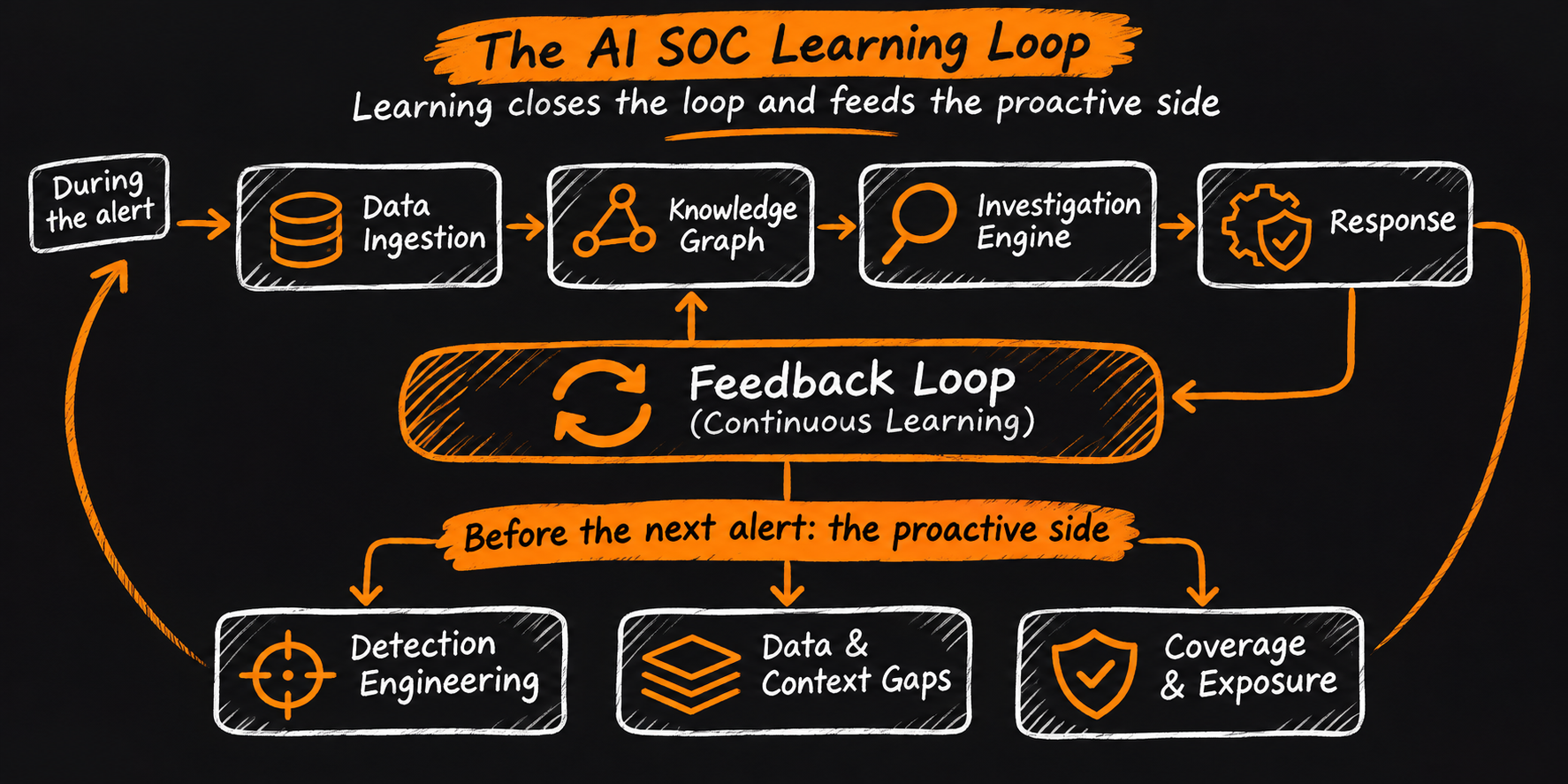
A useful feedback loop produces three different outputs from a case:
- Investigation knowledge: what the team learned about an identity, asset, expected activity, exception, or business process, with the evidence and limits attached.
- Detection and data improvements: rules to create or tune, missing events or fields to collect, and coverage gaps to validate before the next attack.
- Exposure and control improvements: vulnerable assets, risky configurations, or attack paths to prioritize with the teams that can actually fix them.
Each has a different owner and a different check. An investigation note improves context. A proposed detection still needs testing. An exposure finding needs prioritization and remediation. Calling all three “learning” doesn’t make them automatic.
It also doesn’t mean retraining a foundation model on customer tickets. The value is in keeping customer-specific context, decision logic, playbooks, and detection content current and available to the right agents and people.
The alert that keeps coming back
Take a service account that triggers a suspicious-login alert every Sunday during an approved backup job. An analyst investigates, checks the source host and owner, confirms the change window, and closes the case as expected activity.
A purely reactive workflow is finished. The case is closed.
A poorly designed learning loop is worse. It sees the benign verdict and suppresses every future alert involving that account. Convenient, until the same account is abused from an unfamiliar host on Tuesday.
A better loop captures why this instance was expected: the account, the permitted source systems, the scheduled window, the business owner, and the evidence behind the decision. Future investigations reuse that scoped context. Detection engineers can test whether a narrower rule cuts the repetitive noise without hiding unusual activity outside those conditions.
Now suppose the same investigation exposes a logging gap on one of the backup hosts. That finding belongs in the detection and data backlog, not just the case notes. And if a new threat report describes abuse of a similar account, hunters should be able to search across the relevant data sources without rebuilding all that context from scratch.
That’s the distinction. The goal isn’t to teach an agent that a service account is “safe.” It’s to teach the system what was observed, what is expected, what remains uncertain, and what needs to change.
Context you own is part of the security control
An agent can query an EDR for a host and an identity provider for a user and still not know who owns the system, whether the account is privileged for a legitimate reason, or whether the asset supports a business-critical process.
Those answers live in a CMDB, a cloud inventory, an identity platform, a vulnerability scanner, a change system, a spreadsheet, or someone’s head. There is rarely one perfect source of truth, and pretending otherwise is how bad context turns into confident but wrong decisions. Where information is missing or contradictory, the right answer is to flag the uncertainty, not invent a value.
AI can help reconcile and enrich that information, and analyst corrections can reveal stale ownership or undocumented processes. But a case comment is evidence to consider, not permission to rewrite the CMDB.
Context is not paperwork that sits beside the AI SOC. It determines which events are suspicious, which findings matter, and which response actions are appropriate.
Threat intelligence is only preemptive when it drives work
The other side of the loop starts before an alert exists.
A new threat report lands with a campaign description, techniques, and indicators. Summarizing it is the easy part. The useful part is asking what it means for your environment: which assets are relevant, whether you have the telemetry to see those techniques, whether your detections for them have actually been validated, and whether any exposures should move up the remediation queue.
A MITRE ATT&CK mapping is a starting point, not proof of coverage. A rule can be mapped correctly and still fail because the expected event never arrives, the schema is wrong, or the logic is too noisy to keep enabled.
So the work has to continue past the mapping: turn the intelligence into hunt hypotheses, run them across connected sources, build or tune detections as code, test them against historical data, and then check whether coverage actually improved or you just generated a new pile of alerts.
How we’re approaching this at AiStrike
We built AiStrike as a Security Operations Control Plane: one system where triage and investigation, response, detection engineering, threat hunting, and exposure analysis work from the same environment context and act on the same findings. It works with the security tools you already have.
Detection engineering is where the loop becomes a concrete change, so that’s where we put the most weight. Every investigation feeds it. AiStrike assesses the health of existing rules, identifies missing data, creates detection content, and tests and tunes it against historical or simulated data before deployment. Detection content is managed as code through GitHub. For teams moving to a data-lake-centric approach, detections can run against connected lake data rather than requiring every workflow to start in a traditional SIEM.
Hunting and exposure analysis run in the same cycle. AiStrike uses threat intelligence to assess relevant ATT&CK techniques and coverage gaps, and federated search lets teams test hypotheses across connected data sources and SIEMs. Hunts can be saved as hunt packs and run on demand, on a schedule, or in response to new intelligence. Vulnerability information is combined with asset criticality, internet exposure, active threat campaigns, and compensating controls, so the teams who own remediation have a real reason to move one issue ahead of another.
On the reactive side, AiStrike correlates evidence across entities and events, reconstructs timelines, and automates response. The objective is not only a defensible verdict but the evidence and context behind it, because that is the raw material for everything above. The knowledge base and Agent Studio are how organization-specific playbooks, context, tools, and logic get into those workflows.
None of this is useful as an isolated checkbox. A hunt creates an investigation. An investigation exposes missing telemetry. Missing telemetry explains a failed detection. A validated detection improves what the SOC sees next time.
Humans still have a job. High-impact response, rule deployments, and changes to authoritative context go through permissions, validation, and review, and every change the loop makes is scoped and traceable. A SOC that improves itself should be easier to audit, not harder.
Measure what changes, not just what closes
If the only metrics improving are investigation time and tickets closed, you’re measuring the reactive half. Start measuring how much the environment improves because of what the SOC learns:
- Repeat-alert rate: how often the same detection fires for the same benign reason.
- Intel-to-detection time: how long it takes to turn a relevant threat report into a tested detection and hunt.
- Validated coverage: techniques where a detection has been tested against real telemetry, not just mapped.
- Telemetry gaps closed: missing sources and fields found during investigations and actually fixed.
- Exposures moved by evidence: weaknesses reprioritized and remediated because an investigation or threat report showed they matter.
These numbers also keep “continuous learning” honest. An agent that confidently repeats a bad historical verdict isn’t learning. A rule that looks good in a sandbox but fails in production isn’t improved coverage.
The next advantage isn’t another faster agent
We still want faster triage and reliable automation. Analysts shouldn’t spend their days repeating investigations that software can handle.
But speed is the starting point, not the destination. The next step for security operations is to connect what happens during an incident to what the organization changes before the next one: context that gets more accurate, detections that get more effective, hunts that respond to relevant intelligence, and exposures that get prioritized with evidence.
The goal isn’t an AI SOC that closes more alerts. It’s one that gives attackers fewer opportunities to create the next alert in the first place.